

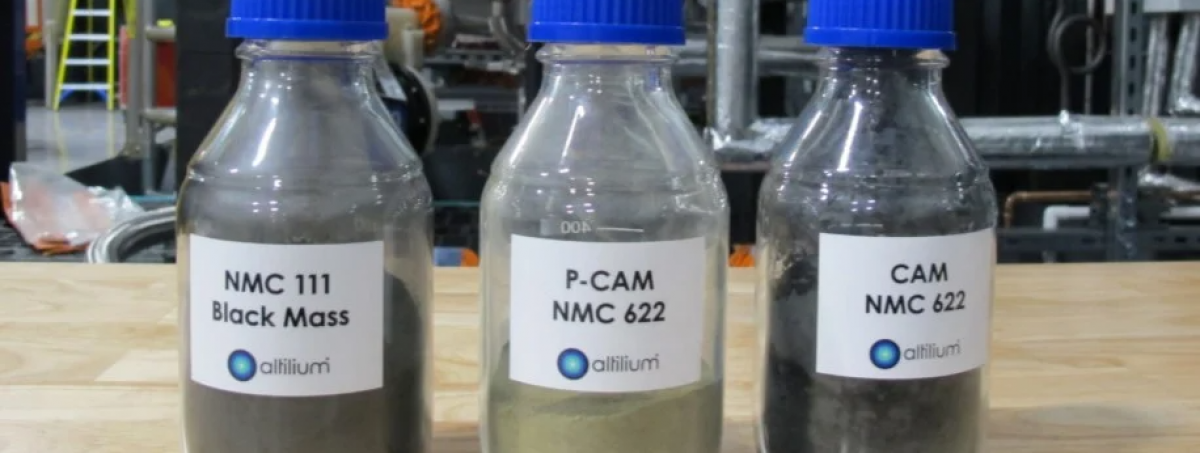
Altilium has secured its first UK patent for its EcoCathode EV battery recycling process, a hydrometallurgical method converting battery black mass into high-purity materials for manufacturing new EV batteries, giving manufacturers a domestically protected route to critical materials that reduces reliance on imported, mined inputs.
Unlike conventional recycling routes, which can produce intermediate materials that often require further refining overseas, Altilium said its process directly recovers and regenerates cathode materials within a closed-loop system, reducing energy consumption and greenhouse gas emissions while cutting reliance on imported critical materials.
The patent, granted by the UK Intellectual Property Office as GB2637908B, covers the core EcoCathode technology and forms part of a wider international portfolio. Altilium said the process has been proven at scale with automotive manufacturers, supported by the Advanced Propulsion Centre, and that Imperial College London testing found recovered materials perform comparably with virgin materials.
The patent comes as Altilium scales its UK recycling operations; its planned ACT4 facility in Teesside would process battery waste from more than 150,000 EVs a year and produce 30,000 tonnes of cathode active material, though the facility remains in development.
Altilium, a UK battery recycling and materials technology firm, began manufacturing the UK's first EV battery cells using recycled cathode materials at its UK Battery Industrialisation Centre in March 2025, and has previously secured backing from Marubeni and Innovate UK.
Christian Marston, co-founder and COO of Altilium, said the patent represents a significant milestone validating years of research into building a circular supply chain for battery materials, and that intellectual property is fundamental to the company's strategy as it scales from pilot operations to commercial production.
The patent reflects a race among battery recyclers to secure IP protection for closed-loop recovery, since intellectual property increasingly determines competitive position and licensing value.
The timing tracks rapid growth: lithium-ion battery recycling patents grew 56 per cent annually between 2017 and 2022, per the IEA, as the global market is forecast to expand from $6.9bn in 2026 to $37.5bn by 2035.
For the sector, patent protection gives Altilium a defensible position while it remains years from commercial-scale operation at Teesside.
Source: electrive.com / IEA / GM Insights





.png)
