

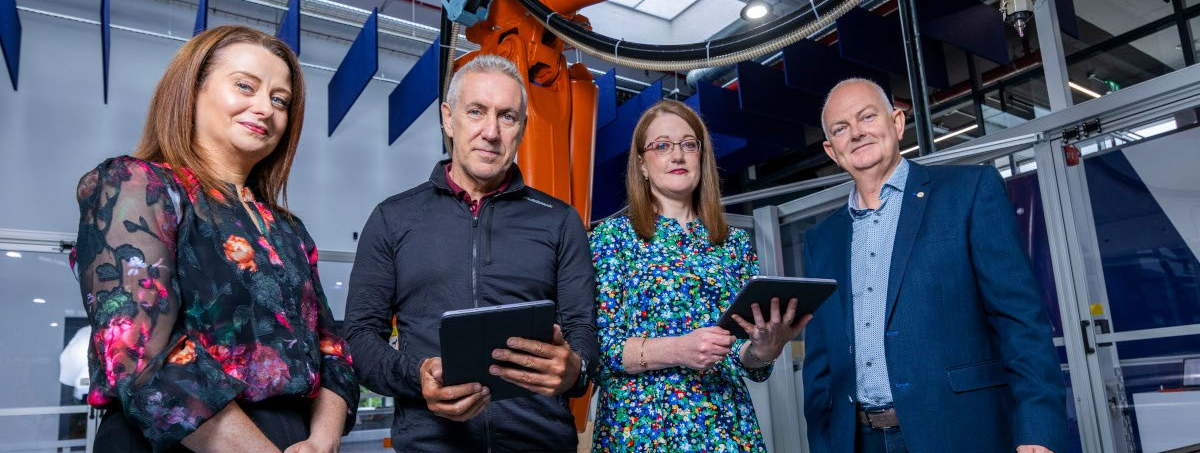
Irish Manufacturing Research has supported 679 industry organisations in 2025, generating economic value worth almost €18m, including €13m in additional revenue and €5m in estimated cost savings, a concrete measure of what testbed access and applied research can add as AI and automation adoption accelerates across the sector.
During the year IMR secured €7.3m in competitive funding, up 26 per cent on the year before, and generated €6.3m in industry income, up from €5.4m in 2024. Its supports also saved or created 32 jobs and upskilled 82 people, based on 31 client impact statements.
More than 10 per cent of collaborating organisations worked with IMR through multiple routes, combining services such as technology projects and workforce training, reflecting deeper, repeat engagement rather than one-off support.
Irish Manufacturing Research, launched in 2014 and modelled on Germany's Fraunhofer Institute and Spain's Tecnalia, is Ireland's national manufacturing research and technology organisation, offering manufacturers a testbed to trial new processes and technology before committing capital, and working directly with universities to build industry-focused roadmaps.
Barry Kennedy, CEO of IMR, said: "The debate about whether AI and automation matter is over. Manufacturers can see the opportunity."
Kennedy said the question now is whether manufacturers have the digital infrastructure, skills and implementation capability to convert that opportunity into commercial value, adding that Ireland has a real opportunity to lead in advanced manufacturing if companies get the right foundations in place.
The results point to a shift among Irish manufacturers from curiosity about AI and automation towards measured commercial deployment, with digital readiness now the binding constraint rather than access to the technology itself.
IMR also leads FactoryxChange, one of Ireland's four European Digital Innovation Hubs and a recent recipient of the European Commission's STEP Seal, and hosts Ireland's first European Space Agency Phi-Lab.
For the sector, the report reinforces that Ireland's advanced manufacturing competitiveness depends as much on applied research infrastructure and workforce upskilling as on direct capital investment, such as Novo Nordisk's €432m expansion of its Athlone manufacturing site earlier this year.
The wider signal for the sector is that competitiveness will increasingly hinge on translating AI and automation investment into working implementation, not simply on the scale of capital committed to new technology.
Source: Silicon Republic / The Irish Times





.png)
